

Wilder feed store
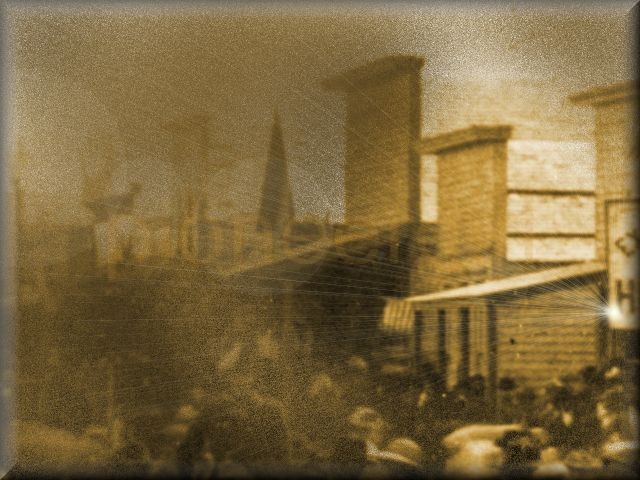
Building on Lot 17, Block 1, in De Smet, used as feed store by Royal Wilder in the 1880s.
 “I say we move in to town for the winter. My feed store beats a claim shanty all hollow for wintering in. We can stay back there till spring. How’d it suit you, Manzo?” – The Long Winter, Chapter 7, “Indian Warning”
 On May 20, 1880, Royal Wilder contracted with Western Town Lots Company to purchase Lot 17, Block 1, original town of De Smet, for fifty dollars. Royal Wilder was the first person to purchase a town lot in De Smet! Local history has always maintained that Henry Hinz bought the first lot, but his was purchased on June 7. Hinz may have had the distinction of trying to second guess the surveyors and be the first to stake a physical claim to the lot closest to the railroad – a most desirable location – but when the surveyors had done their work, Hinz was found to be two lots off, so Charles Mead ended up with the last two lots for his hotel.
Many publications identify the incorrect building as Wilder feed in early photographs; some even identify a building not even on the lot Royal purchased. Royal’s building was one story with a peaked roof behind a tall square false front. There was a center door with a window on each side, and the circa 1885 photograph at right shows an awning rolled and tied above the windows.
Wilder Feed is important in the Little House books because this is where Almanzo Wilder stored his seed wheat during the Hard Winter of 1880-1881, and where Charles Ingalls went to purchase some of that wheat from Almanzo when the Ingallses were out of food (see The Long Winter, Chapter 23, “The Wheat in the Wall”). It doesn’t seem that Royal Wilder was in the feed business for very long, and no advertisements for his feed store appear in early newspapers. By 1887, Royal was operating a variety store in his building, yet it was rented out when he began spending more and more time in Spring Valley, finally moving there permanently and simply abandoning Lot 17, owing years of back taxes on the property.
 In 1905, the De Smet News reported that the “old Wilder building on Calumet” stood with its door open and windows broken out. The building was said to be old and dilapidated and unfit for occupancy, and publisher Carter Sherwood said it would be no loss to the owner or the town if it was condemned and torn down. But it sat in disrepair for over three more years.
In April 1909, the De Smet City Council ordered that the building be town down or repaired, as it was a fire trap. From Spring Valley, Royal sold the lot and building to George Burd in June 1909, who paid $350. The lot and building was almost immediately sold to Thomas Mears, who owned other property on the block. Mears had the building torn down in July 1909 and he built a garage in its place. The photograph below shows the new building constructed the following year; note the sign above says “GARAGE.” This is the building most people mistake for Wilder Feed in old photographs, but this two story building dates from 1909.
Next time you’re in De Smet and want to know where Royal’s lot was on Calumet Avenue, go to the north end of Calumet at 1st Street. Maynard’s Food Center is on the west side of Calumet. The circle “M” logo on the grocery store is pretty much in the center of Lot 17 of Block 1, which was the lot Royal owned. Google street view is HERE, or look at the poorly-pieced image below to get your bearings (click on image for full size). Today, the businesses on that block from south to north are: Ward’s Store, Klinkel’s III, U.S. Post office, Lewis Family Drug / Maynard’s Food Center.

There are two well-known 1912 panoramic photos of De Smet taken by Clifford McKibben; there’s also a circa 1905 panoramic photo taken of De Smet from the south (its photographer is unknown). Read about them HERE. There’s also a lesser-known (until now, anyway) circa 1904 panoramic photo that includes a partial view of WILDER’S VARIETY STORE, taken from the courthouse roof.
There was another panoramic photo taken from the courthouse roof. I’ve only seen it in print at the Depot Museum and the Oxbow Restaurant in De Smet. It shows up in THIS PHOTO taken at the Oxbow Restaurant, and if you run over there to snap your own photo, for pete’s sake, at least have lunch or a piece of pie first.
No, it’s not the 1912 photo taken by Clifford McKibben from the courthouse roof shown HERE.
In 2012, I took a bunch of photos of the Oxbow / Depot photos, which are small prints, maybe 6 inches by 2 feet, whereas the 1912 McKibben photo was almost 4 feet wide. The 1912 photo is a single print whereas the two prints I’ve seen of this panoramic are made up of separate photos pieced together – which don’t line up exactly at the seams. I think it took me 17 photos with whatever digital camera I was using back then to piece together the whole thing, even though the framed photos aren’t that big.
It wasn’t until years later that I noticed that this panoramic includes one of the few shots of ROYAL WILDER’S BUILDING — well, most of it, anyway — on Lot 17, Block 1, original plat of De Smet. At the time this photo was taken, the building was still owned by Royal but he’d moved back to Spring Valley and had abandoned it.
In the summer of 1889, having made final proof on both his homestead and tree claim in Kingsbury County, Royal was behind in paying taxes and in need of cash. Royal stocked his Lot 17 building with notions and opened “Wilder’s Variety Store.” His store was mentioned in local newspapers extensively for about a year.
In December 1889, Royal sold his property in Spring Valley from De Smet. He ran the De Smet store through the winter of 1889-1890, and after a spring 1890 visit to Spring Valley, Royal left De Smet for an extended trip to the east that fall. He wrote to Carter Sherwood that he was visiting scenes of his boyhood in New York, as well as visiting New Jersey, Virginia, Boston, Washington D.C., and Philadelphia. He made another trip to Spring Valley in the fall of 1891, and that December, he opened a “Wilder’s Variety Store” in Spring Valley.
Royal left Charles Ingalls in charge of the De Smet store after opening the one in Spring Valley. The De Smet Leader dated December 18, 1891, reported: “Ingalls & Co. — C.P. Ingalls & Co. are successors to the store and business of R.G. Wilder. Mr. Ingalls has sorted up the stock, which was pretty well run down, and will be glad to have would-be-purchasers call and see him before buying.”
Royal returned to De Smet in 1896 and reopened the variety store in his old building for a while, and he often sold his wares across the county from a peddler’s cart. At some point in 1900, Royal moved back to Spring Valley for good.
From 1886 to 1900, Royal rented out his store building between stints of conducting business there himself; at various times, his building housed a general store, harness shop, barber shop, butcher shop and meat market, none of them run by Royal Wilder. When Royal left De Smet for good in 1900, he still owned his original store building, which fell into disrepair and often stood empty. In the November 17, 1905 issue of the Kingsbury County Independent, it was noted that “the old Wilder building on Calumet Avenue stands with door open and window glass out. Whoever has charge of the building should see to it that all openings are boarded up and the building made secure against entrance by tramps or children. A vacant building standing open always collects a lot of rubbish and becomes a fire trap as well as unsanitary. This building is old and dilapidated, not fit for occupancy, and, as a matter of fact, it would be no loss to the owner or to the town if it was condemned and torn down.”
Four years later, Royal’s building was standing in ruin. In April 1909, the De Smet City Council ordered that the building be torn down or repaired, as it was a fire trap. The April 16, 1909 De Smet News reported that “The old Wilder building on the west side of main street is not only unsightly, but it is a fire trap. The city council has ordered that it be either removed or repaired.”
Royal sold the lot/building in June 1909; it was purchased for $350 by George Burd, the father-in-law of Little House character Frank Harthorn. The lot/building was almost immediately sold by Burd to Thomas Mears (1849-1937), who had the building torn down in July 1909. Mears built a two-story cement block building in its place, in which he ran an automobile sales floor, garage, and repair shop. The Mears building appears in many photos of the west side of Calumet and it’s often mistaken for Royal Wilder’s store building, but it’s not.
The building in the panoramic is the original Wilder building, where Royal and Almanzo Wilder spent the Hard Winter of 1880-1881.
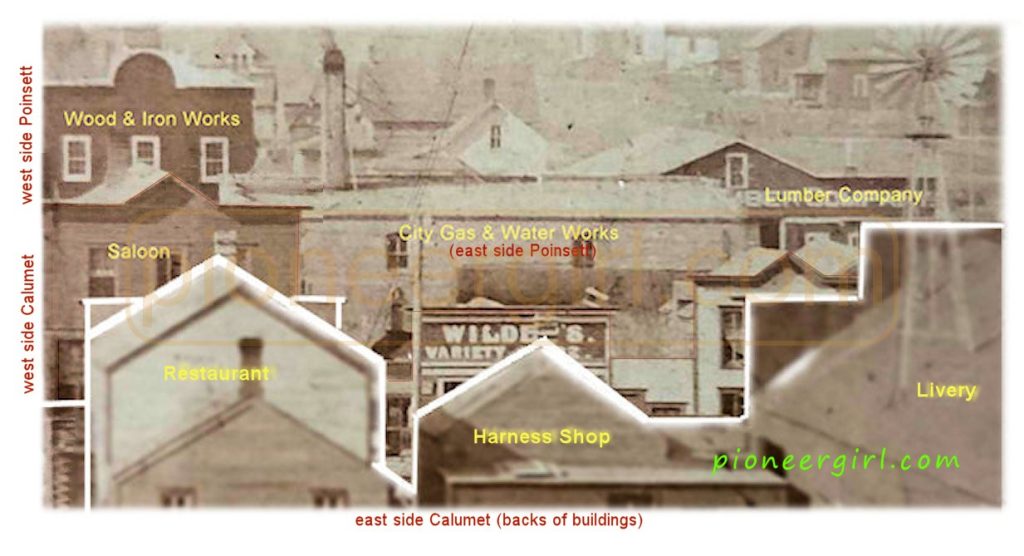
When De Smet is photographed from the courthouse roof, the photographer looks west — down and across buildings on both sides of multiple town blocks. The buildings closest to the photographer on the above image (which I outlined in white) are the backs of buildings on Calumet facing west on Block 2. These are identified as a restaurant, harness shop, and livery, which is what they were at the time the photo was taken.
Across Calumet facing east on Block 1, is a saloon, Wilder’s Variety Store, and another saloon.
Behind them and also on Block 1 but facing west on the east side of Poinsett (Highway 25 today), is the city gas and water works. You can see its smokestack.
On the west side of Poinsett (on part of Block 9, Brown’s Addition, which was taken over by the curve in Highway 25) is W.C. White’s Wood & Iron Works and the De Smet Lumber Company.
The buildings that are at the right side and angled off to the west are on the north side of First Street, just south of the railroad tracks.
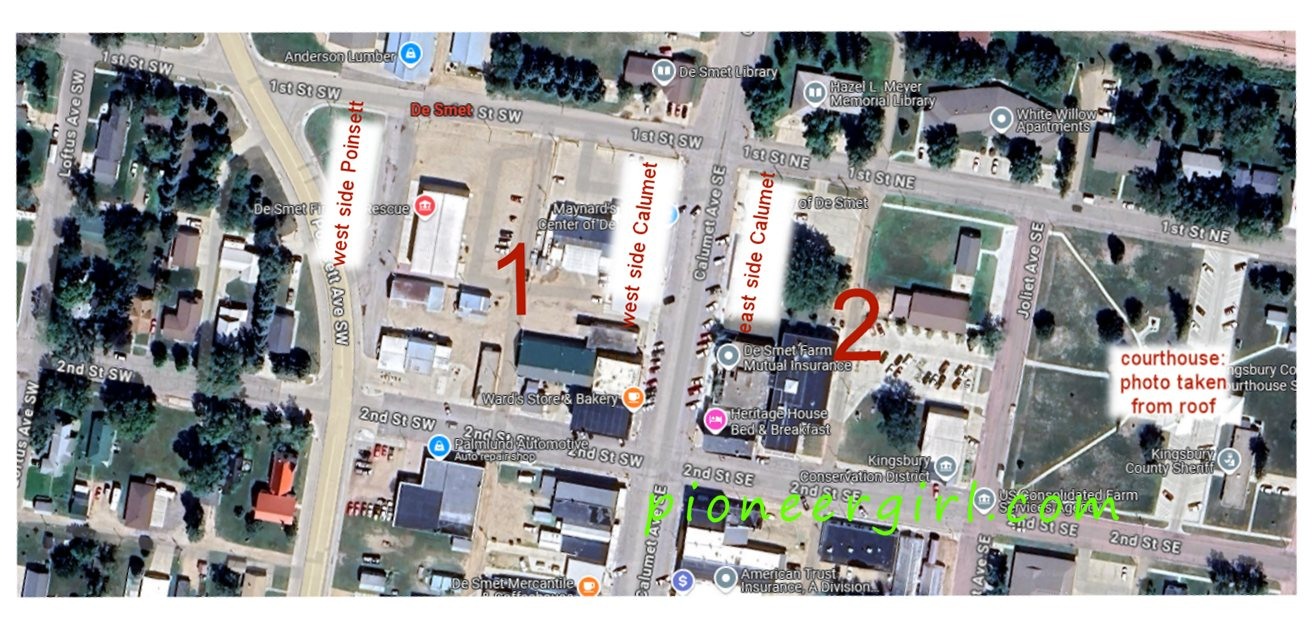
If you’re not familiar with De Smet, I’ve labeled where the three tiers of buildings in the above photo. Google aerial is HERE in case you want to go to street view and look around.
1️⃣Wood & Iron Works and De Smet Lumber Co. (west side of Poinsett). This is the block north of where Prairie Baptist Church is today.
2️⃣Saloon, Wilder’s Variety Store, Saloon (west side of Calumet) — waterworks / gas plant behind them. De Smet Fire & Rescue is near where the gas plant was. Saloons and Wilders were where Lewis Drug / Maynards is today.
3️⃣Restaurant, Harness Shop, Livery (east side of Calumet). Between City Hall and DS Farm Mutual today.
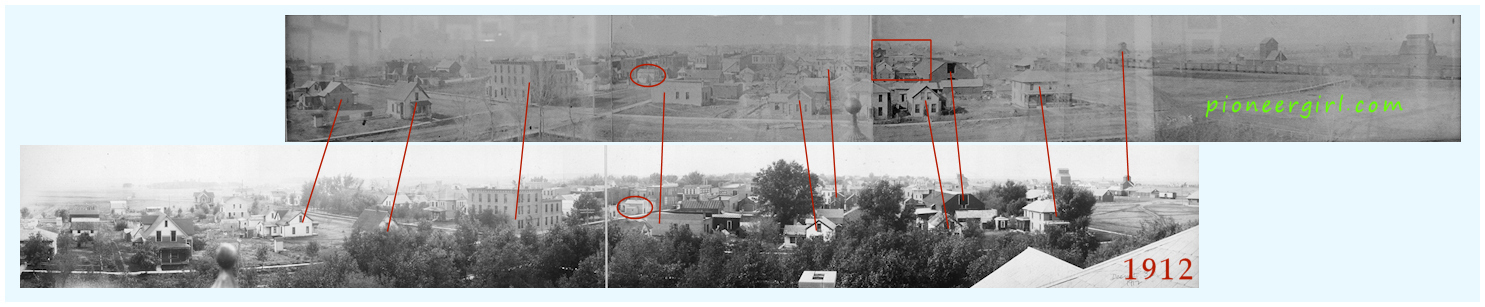
The 1912 panoramic photo by McKibben and the earlier courthouse panoramic photo are shown below for comparison. Click image for larger view. There are a LOT of clues in the undated panoramic photograph that helped me determine that the photo was taken between October 1903 and mid-July 1904.

Wilder feed store (TLW 9-10; LTP 6) – see also Royal Wilder; Pre-1906 amd 1912 De Smet Panoramic Photos