

lemon
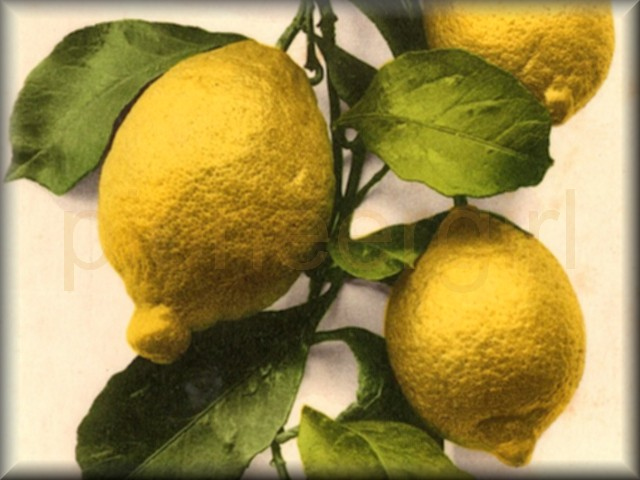
lemon. An oval or roundish fruit resembling the orange, and containing an intensely acid pulp. It is produced by a tropical tree of the genus Citrus, the common fruit known in commerce being that of the species C. limonum. There are many varieties of the fruit, some of which are even sweet. — Webster, 1882
lemonade. A beverage consisting of lemon-juice mixed with water and sweetened. — Webster, 1882
 Fourth of July. An oration at the Baptist Church in Malone will be delivered by William P. Cantwell, Esq., of Malone… Music will be provided and other exercises fitting the occasion. Services to commence at 11 o’clock a.m. Immediately after the conclusion of the exercises, a dinner will be served at the church hall, and after the dinner, lemonade, strawberries and ice cream will be provided during the remainder of the day and evening. — Malone Palladium, June 22, 1865.
Lemonade is one of the best and safest drinks for a person, whether in health or not. It is suitable to all stomach diseases; is excellent in sickness. The pips, crushed, may also be mixed with water and used as a drink. We advise every one to rub the gums daily with lemon juice to keep them in health. The hands and nails are also kept clean, white, soft and supple by the use of lemon instead of soap. It also prevents chilblains. Lemon is used in intermittent fevers, mixed with strong, hot, black coffee without sugar. Neuralgia may be cured by rubbing the parts affected with a cut lemon. It is valuable also to cure warts and to destroy dandruff on the head by rubbing the roots of the hair with it. — Redwood Gazette, July 22, 1880.
Oranges, 30 and 50 cents a dozen. Lemons, 50 cents a dozen. — Redwood Gazette, February 13, 1879.
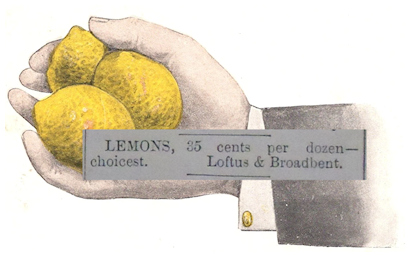
Lemons, 35 cents per dozen – choicest. Loftus & Broadbent. — Kingsbury County News, July 6, 1888.
Laura’s Gingerbread and lemonade in a crock to be sold at Old Settlers’ Day. — De Smet News, June 9, 1966.
 Laura Ingalls Wilder first mentions lemonade in Farmer Boy: While filling the ice house during the winter, Almanzo Wilder thinks about summer days in which Mother Wilder would use that ice to chill both egg-nog and lemonade, and for freezing ice-cream. On the Fourth of July, pink lemonade is for sale in Malone for five cents a glass, and while Almanzo’s cousin Frank buys some, Almanzo uses the half dollar Father Wilder gives him to purchase Lucy the piglet! That fall, lemonade is sold at the County Fair, but we never read about Almanzo enjoying any.
Laura Ingalls gets her own first taste of lemonade at Nellie Olesons town party in On the Banks of Plum Creek. Mrs. Oleson serves the children cake and lemonade, asking Laura: “Is your lemonade sweet enough?” …Laura had never tasted anything like it. At first it was sweet, but after she ate a bit of the sugar-white off her piece of cake, the lemonade was sour.
In Little Town on the Prairie, Pa, Laura and Carrie walk to De Smet for the Fourth of July celebration after the Hard Winter. There’s free lemonade! Barrels of it stand in the grass by the flagpole, and everyone takes turns drinking some from the communal tin dipper. Carrie’s eyes grow round with delight when she tastes it; she had never tasted lemonade before.
To Laura, this lemonade was even more delicious than she remembered from Plum Creek. The barrel was almost full, and pieces of lemon floated thickly on the surface. The lemonade had been made with cold water from the hotel well, and it had plenty of sugar so it was very sweet.
Lemonade again appears at Fourth of July celebrations in These Happy Golden Years. Pa brings lemons home from town one year, and the whole family enjoys lemonade at home. After Almanzo and Laura are engaged, he and Laura ride into town for the fireworks, then back to Pa’s homestead for cold chicken and pie, cake, and a pitcher of Ma’s lemonade made with fresh, cold water from their own well.
Superior Lemonade. Take the peel of six lemons, free from pith, cut it up in small pieces, and put it with two cloves into a bottle containing half a pint of hot water, place the bottle in a stewpan with boiling water, and let it stand by the side of a fire for one or two hours, taking care it does not boil; then take half a pint of lemon-juice, half a pint of syrup, if none, use plain syrup, or sugar, in like proportion, adding a few drops of orange-flower water; add the infusion of the rind, which has been previously made, and allowed to become cold, stir well together, and add two quarts of cold water. — Godey’s Lady’s Book and Magazine (Vol. LXXVI, No. 456, June 1868), 548.
Prairie Lemonade. Mix two cups of sugar with one quart of water. Bring to a boil, stirring constantly until sugar is dissolved. Set aside to cool. Slice ten lemons into thin slices and place in a bowl. Pour cooled syrup over the lemons and set aside for several hours. To serve, add two quarts of cold water to the lemons and syrup, and stir, mashing the lemon slices with the back of the spoon to release their juice. To serve: strain the mixture and serve over ice, or drink by the dipperful as Laura and Carrie did.
For pink lemonade, tint regular lemonade with mashed ripe strawberry pulp (strained), sweetened beetroot juice, or pomegranate juice. In a pinch, you can resort to a drop or two of red or pink food coloring.
An Excellent Lemon Pie. To one grated lemon take two-thirds cup of white sugar, one egg, the yolks of three well beaten, two tablespoons of corn starch, tartaric acid the size of two small beans, a pint and a half of boiling water. This will make two pies. Beat the whites of the eggs to a froth; add two tablespoons of white sugar. When your pies are done put the frosting over them and let it slightly brown. — Redwood Gazette, October 4, 1877.
Lemon Pie. Line a common sized pie plate with crust, rubbing it as full of flour as you can. Take one large lemon, grate off the yellow part and squeeze the juice into the middle of the pie; place the pulp around the edge, one egg, beaten with three fourths of a cup of white sugar, one half cup of cold water, sprinkle in some of the grated rind, and cover with a crust. — Redwood Gazette, May 26, 1881.
Mrs. Daniel H. Loftus’s Lemon Pie. One cup sugar, twl tablespoons corn starch, juice and grated rind of one lemon, butter the size of an egg,m one cup hot water. Cook until clear; let cool, then add the yolk of one egg and use the white for frosting. — Cream City Cook Book, Compiled by Aid Society, Congregational Church, De Smet, So. Dak., 1904-1914.
In her handwritten Pioneer Girl memoir, Laura wrote that lemon pie was the only kind she liked as a child, and that when she and Mary attended a Sunday school picnic in Walnut Grove, Ma included in their lunch basket a whole lemon pie. But when the Sunday school teachers took the lunches out of the various baskets and set them out, they kept back the Ingallses’ lemon pie for just the teachers, rationalizing that there wasn’t “enough to go around anyhow.”
Laura used a more detailed version of the published Fourth of July story in her handwritten manuscript for Little Town on the Prairie, in which no lemon pie is mentioned. In the manuscript, Laura tells us how lemon pie was made in the days before graham cracker crusts and canned condensed milk:
“Now for the lemon pie,” Ma said… “Laura you wash the lemons carefully and cut off any dark spots, while I make the crust.” Ma added a pinch of salt to some flour. With her fingers she crumbled lard through it, until the particles would pact [sic] together when pinched. Then she added a little cold water as she mixed it in lightly to make a dough. Now she rolled the dough out thin and lined a pie-tin with it. She cut the lemons into very thin slices and laid them on the crust until the pie-tin was nearly filled. Then she covered them with sugar – Oh lots and lots of sugar. Over this she placed the top crust, with its small pine-tree cut in the center, and she baked the pie until the flakey crust was a delicate light brown.
Lemon candy. In These Happy Golden Years (see Chapter 23, “Barnum Walks”), during the intermission at singing school, the young men bring out striped sacks of candy sticks to share with the young ladies in class. In addition to peppermint balls and horehound candy, there are “sticks of lemon candy and peppermint candy.” Unlike candy canes with a curved end, these would have been long, straight pieces of candy purchased at one of the stores in town. The stores of A.S. Carpenter, E.R. Bennett Grocery, J.W. Cline, D.C. Noyes all advertised candy for sale in De Smet over the years, and surely Dan Loftus and Edelbert Harthorn sold candy in their stores. Clint Noyes – whose store location Laura labeled on one of her maps drawn of businesses up and down Calumet Avenue but didn’t mention in the Little House books – had a dedicated candy counter in his store during the years 1884-1885, and he also made candy by hand.
Stick candy involves boiling granulated sugar, water, and ingredients to prevent crystallization to a high temperature, then pouring it out to cool slightly, where coloring (if desired) and flavoring are added. The candy is folded or pulled by hand or machinery to incorporate air. It is then pulled and rolled into a long, thin rope that is cut by hand or machine into the desired stick length. You can find lots of candy-making videos online, and old-fashioned lemon stick candy is readily available for purchase.
In the early 1990s, Friendship House Bed & Breakfast in Mansfield, Missouri – originally built by Silas and Neta Seal as a boarding house and often visited by Laura and Almanzo – offered homemade hard candy to guests. It’s something I’ll always remember. The recipe used was the one found on the Karo syrup bottle in the early years, and is the lollipop recipe found on their website.
To make, lightly butter a shallow baking pan and set aside. Mix2 cups granulated sugar, 1 cup corn syrup, and 1 cup water in a non-reactive pan and boil without stirring to the hard crack stage (or 300 degrees F. on a candy thermometer). Remove from the heat and add 1 & 1/2 teaspoon lemon flavoring oil and 3 drops of yellow to 1/2 teaspoon yellow food coloring and stir to combine. Pour the hot syrup into the buttered pan. As soon as the candy slab cools enough to handle, lift a corner and cut the candy into small pieces with buttered kitchen shears. Drop the pieces into a dish of powdered sugar to coat and prevent the candy from sticking together. Store candies in an airtight container.

lemon (LTP 2, 8; THGY 21)
candy sticks (THGY 23)
lemonade (FB 6, 16; BPC 22; LTP 8; THGY 21, 28; PG) –
lemonade made in a hogshead barrel (LTP 8)
lemonade-stand (FB 16)
pie (PG)
pink lemonade (FB 16, 21)
lemon verbena – The real Laura Ingalls Wilder never mentioned lemon verbena. Not the plant, not the scent, not in any manuscript or Little House book or Ruralist article, not once. Period. In connection with Laura Ingalls, lemon verbena was first mentioned in Season 1 of the Little House on the Prairie television show, when it was identified as the scent worn by Miss Beadle, Laura’s teacher in Walnut Grove.