

bureau
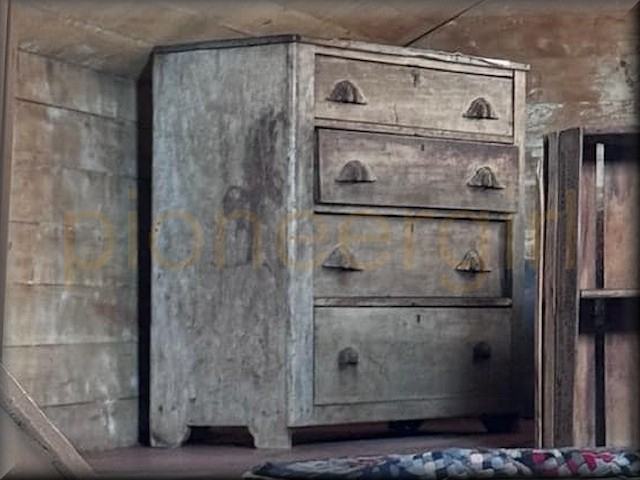
A chest of drawers for clothes, &c., especially when made an ornamental piece of furniture. This sense comes naturally from the original meaning, a desk or writing table, with drawers for papers. — Webster, 1882
 Railroad Shanty restoration attracts many. Stairway that had for years risen along the north wall of the building was replaced to rise from the center of the main room. Board floor not the original, as a hardwood floor had been laid over it. Organ is first one used in Congregational church, but no association with the Ingalls family other than seen and heard by them. Chest of drawers made by C.P. Ingalls has been in storage for some years. The lean-to annex to the original shanty, the kitchen of the residence through its years of location in De Smet, will serve as reception room at the shanty. – De Smet News, June 27, 1968.
 In Farmer Boy, the Wilders have more than one bureau – a dresser or chest of drawers – as there is one in both Mother and Father Wilder’s room as well as in the upstairs bedroom that Royal and Almanzo share. Mrs. Woodworth has white knitted lace on her bureau, which Laura notices when she and her friends attend Ben’s birthday party. Wilder also noted that there was a bureau among Almanzo’s things in their first home on his tree claim. The first mention of a bureau owned by the Ingallses is in Little Town on the Prairie (see Chapter 12, “Snug for Winter”) when Laura is packing clothes from its bottom drawer in preparation for the family’s move to town the winter after Mary goes to college, meaning the winter of 1881-1882. The shanty’s furniture is moved to town while the girls are in school one day.
Where did the bureau come from? When the Ingallses first move to the homestead (see By the Shores of Silver Lake, “Chapter 29, “The Shanty on the Claim”), they have trouble fitting all the furniture inside the half shanty, and the layout and furnishings are described in detail: the three bedsteads, stove, trunk, table and chairs, two rocking chairs, and the whatnot Pa build during their winter in the Surveyors’ House. The girls’ boxes of things go under the beds, not at the foot of them. A bureau isn’t mentioned in The Long Winter, suggesting that it was left in their town building when they moved to the homestead or that Pa built the dresser at some point after the Hard Winter, when he built the “missing half” of the claim shanty that became two tiny bedrooms.
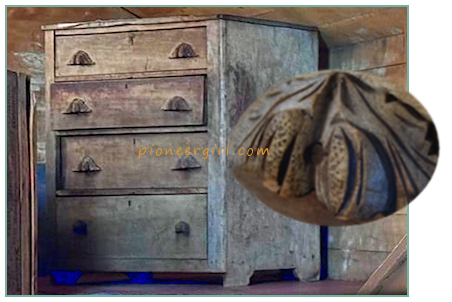
It’s long been accepted that the bureau was built by Charles Ingalls; could he have used lumber left over from the shanty addition? It appears to be of fairly simple construction. Note that there are no separate feet to the dresser as is typical; the two side boards continue to the floor in one piece and are cut out to suggest legs, but only from the sides. Museum workers have examined the dresser inside and out and reported that there are no commercial or maker’s markings anywhere. The dresser had “long been in storage” before it was display in the Surveyors’ House. Over the decades, it’s been placed between the stair door and the main floor bedroom door, to the left of the front door, beside the door to the lean-to, and most recently, upstairs in the Ingalls’ sisters’ former bedroom. All four drawers have key holes, but it’s unknown if there are functional locks or “for show only,” and if functional, are the locks inset or simply screwed / nailed to the inside of the drawer? The top three drawers have widely available and popular Victorian “fruit and leaf” or “nut and leaf” pulls attached with a single screw (shown inset). Are there other holes visible inside the drawers that suggest these were replacement pulls? Were they made by Charles Ingalls, purchased, or a later addition? Furniture catalogs from the late 1870s show that such pulls were often sold in sets of six, and that a commercially built 4-drawer bureau could be purchased for about six dollars. Are the drawers dovetailed? Are they screwed or nailed together? Are the drawers partitioned in any way? Is there evidence of stain or paint inside or out? Are the side boards one piece of wood, or two? The wood seems to have weathered a lot since the bureau was photographed for a 1974 postcard; how is Pa’s dresser being cared for today?
According to Ingalls lore, in 1944, Carrie no longer wished to fool with renting out the Third Street house, so she agreed to sell it to Peter Ferguson. At the time, one of the upstairs rooms was still filled with old Ingalls items. Two years later, the items were still there and the Fergusons wanted to use the room, so a friend of Carrie’s sorted out a few items that she thought Carrie might want, and shipped them to Keystone. The friend, Mrs. Sterr, wished to sell the remaining items in her store in De Smet, but Carrie died before the arrangement could be discussed, and most of what was upstairs was discarded. The bureau, “filled with books” (such as Pa’s big green animal book and a volume of Mary’s raised print Bible) went to Grace’s friend in Manchester, the spinster Maude Noble (1878-1956), then in her sixties. Maude and Grace were both members of the “birthday club” in Manchester. At some point after Maude’s marriage a few years later to widower John Rundell (1880-1955), the bureau was stored in the De Smet News warehouse. And aren’t we glad it was!?

bureau (FB 3, 13; LTP 12, 18, 20; THGY 1)