

Singing School
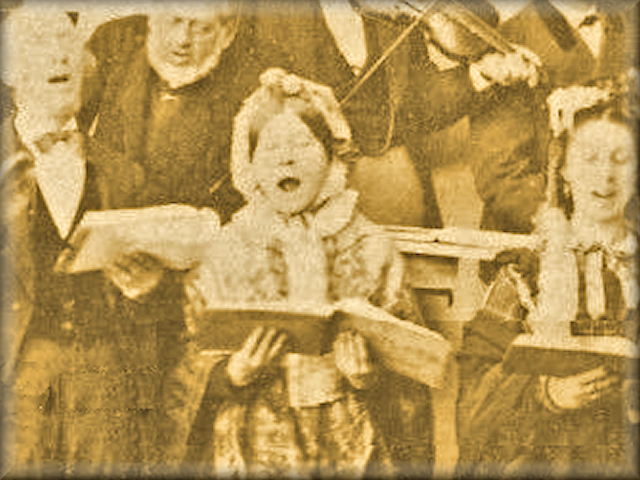
Lessons in which students are taught to sightread vocal music.
 A singing school will be started soon in De Smet, by Mr. E.A. Forbush, a sufficient number having pledged support. Come out, everybody, and brush up your dormant musical faculties. It will afford you fun and profit. – Iroquois Herald, February 8, 1884.
A card: Having moved to De Smet I wish to announce to the public that I am prepared to tune and repair pianos and organs. Also want to organize classes in piano, organ, and voice culture. I expect to organize a singing school soon. Those interested in music will do me a great favor by calling on me. First door south of P.O. – G. C. Westervelt. -De Smet Leader, November 29, 1884.
 Last week, I noticed a mistake here on my website (it happens) which led me on a tangent re-researching Willard Seelye, Edwin Forbush, and James Clewett and his brother Frank, trying to determine once and for all which singing school class Laura & Almanzo attended.
Part of the trouble is that Wilder placed so many historical events out of order in fictional Little Town on the Prairie and These Happy Golden Years. She has Miss Wilder, Mr. Clewett, Mr. Seelye, and Mr. Owen all teaching terms of school in years other than those they actually taught. The fictional Brewster School takes place in the wrong year than the historical Bouchie School did, which throws off the Laura / Almanzo courtship sequence of events.
Although Willard Seelye was always singing and performing at De Smet events in real life, he didn’t ever teach singing school in town (and Laura didn’t remember him fondly in her Pioneer Girl memoir). James Clewett didn’t teach singing school (Laura may have used his name because she did remember him fondly); his relatives — even when I was corresponding with a great-grandson decades ago — didn’t know he’d even taught regular school, much less anything outside the classroom. In addition to his one term in De Smet, Clewett taught schools in both Lake Preston and Iroquois for years. Neither George Westervelt nor Edwin Forbush are named in the Little House books at all; both were trained musicians and both were choral, band, and orchestra leaders in Kingsbury County and both definitely organized and taught singing school in De Smet during the Little House years. Neither taught an academic term in De Smet schools, however.
In These Happy Golden Years (see Chapter 21, “Barnum and Skip”), singing school – that there’s to be one – is first mentioned at the end of one of Laura and Almanzo’s horse-breaking buggy rides on the last Sunday in August during the calendar year in which Laura teaches both the Brewster and Perry schools. It’s the summer that Pa buys an organ for Mary, but Mary doesn’t come home from college that year. The next chapter is titled “Singing School” and school has started in the new two-story brick schoolhouse with two teachers. Florence Wilkins (historically, her surname was Wilkin) is a new student and she quickly becomes one of Laura’s friends. Singing school is held in the church and seems to start in September; Almanzo drives himself and Laura there behind the still skittish Barnum and Skip hitched to the buggy, and they have to leave each class early so the horses aren’t frightened by all the people. Singing school meets on a day that isn’t Sunday, because Almanzo reminds Laura that he would be around on Sunday for their usual buggy ride. Singing school lasts long enough for the students to sing their way through all 144 pages pages of the singing school book.
 Laura’s singing school book was called The Conqueror; it was written by C.E. Leslie and R.H. Randall and published in 1880 by The Chicago Music Company. Leslie wrote a number of hymnals and singing school books, and he traveled widely, promoting his program and holding classes in a number of states. Many of the songs in The Conqueror were composed by Leslie or Randall. Laura’s singing school book originally cost seventy-five cents and is today on display at the Laura Ingalls Wilder / Rose Wilder Lane Home and Museum in Mansfield, Missouri. The singing book begins as Wilder wrote in These Happy Golden Years, with an explanation of notes, rests, and clefs. It then continues with simple exercises, starting with “do re mi fa sol la si do” and moving on to simple songs.
You can see copies of the singing school book HERE (via Google books) and HERE (via Internet Archive). Copies are frequently for sale on ebay.
There were three separate singing school classes advertised and written about in Kingsbury County newspapers. They were held:
1️⃣ Beginning after the second week in February 1884, taught by E.A. Forbush, and meeting in the Congregational Church;
2️⃣ Organized in December 1884 with classes beginning in January 1885 and ending with a concert given in April 1885; these classes were taught by George Westervelt in the Congregational Church; and,
3️⃣ Classes beginning in January 1886, taught by George Westervelt in his home, with a concert given on February 9th.
Note that all classes mentioned were held during winter months. Laura & Almanzo could have attended the first session taught by Mr. Forbush, but it would have been right on the heels of Laura’s two months teaching the Bouchie School when she and Almanzo were both living in town. Although Wilder wrote that she earned her first teaching certificate in December 1882, historically she earned her first certificate on December 10, 1883, and taught the two-month Bouchie school shortly after. If this was the singing school that Laura and Almanzo attended, it suggests that they were already a courting couple near the end of Laura’s first term teaching, and she fictionalized not wanting to continue seeing Almanzo after her term ended, as she wrote in These Happy Golden Years. The De Smet Leader on Saturday, February 16th reported:
“Singing school this evening at 7 in Cong’l church.” And, the next week: “Mr. Forbush opened his singing school at the church last Saturday evening, with a good attendance. It will be held hereafter on Saturday and Monday evenings. He is a thoroughly competent teacher, and the musically inclined will find pleasure and profit in attending the school.” On March 1st: “Mr. Forbush’s singing school is growing in numbers and doing good work,” and on March 29th, the newspaper passed along the information that beginning on April 5th, singing school would go back to only being held on Saturday evenings in order “to accommodate those living in the country who are busy with spring work,” such as Almanzo Wilder on his homestead and tree claim. Classes were still apparently in session on April 19th.
In These Happy Golden Years, singing school is written as if it begins after school starts in the fall of 1884. Laura wrote that classes were held in the new schoolhouse that term, but the new schoolhouse was actually dedicated on January 1, 1885, with the first classes held in the new building that week. In real life, George Westervelt was living in the Ingalls building in town by October of that year (1884); he was mentioned as the renter multiple times in local papers. Classes were advertised as being held in the Congregational Church. This is the most likely session that Laura and Almanzo attended; since the Ingallses were living on the homestead that winter, it would involve Laura being picked up by Almanzo and taken into town by him, with some of the classes held in spring buggy-riding weather. Almanzo and Royal Wilder had left De Smet in November and initially planned to be away all winter, but the brothers were back in town before Christmas 1884. Laura contracted to teach the Wilkin school on April 14 and began teaching on Monday, April 20, 1885, and if the concert was given prior to this or the last weekend in April (with weekends spent at home, thanks to Almanzo), it wouldn’t have interfered with Laura’s school.
The third singing school was again taught by George Westervelt. The reason the Westervelts rented the Ingalls building in 1884 was because Westervelt was building a house on Second Street that winter. The house was located on the same block as the Ingallses’ future Third Street house but located right behind (north of) the lot owned by Tom Quiner. This third singing school was held the winter after Laura and Almanzo were married and right before Laura became pregnant with Rose.
In the Wilder collection at the Laura Ingalls Wilder Home & Museum in Mansfield, Missouri, is a handwritten note which reads: “Ye Greate Concert, 4 + 20 persons at ye meeting house of Ye Firste Parishe De Smet Dakota Territory on ye ninth of ye second month MDCCCLXXXVI.” If you’re not up on your Roman Numerals, the concert was on February 9, 1886.
Maybe the invitation kept was an invitation to Laura & Almanzo from Carrie or from one of Laura’s still-in-school friends? Or maybe the Wilders were invited because they’d attended Mr. Westervelt’s singing school the previous winter? Who knows? Singing school just sounds like something a dozen young couples would enjoy doing winter evenings, plus the invitation clearly meant enough to Laura that she hung onto it the rest of her life. You know, like she held onto her invitation to Ben’s birthday party and the first essay she ever wrote – both of which were written about in the Little House books.
Songs mentioned in connection with Laura’s singing school in These Happy Golden Years, as well as in Pioneer Girl or Little House books or manuscripts, and included in The Conqueror include:
“Gaily Now Our Boat is Sailing” (page 7)
“Three Blind Mice” (page 8)
“Song of the Grass” (page 16)
“Don’t Leave the Farm, Boys” (page 24)
“Blame Yourself if You’re Sold” (page 96)
“We All Have a Very Bad Cold” (page 106)
“Temperance Anthem” / “Wine is a Mocker” (page 117}
“Great is the Lord” (page 128)
“The Heavens Declare the Glory” (page 144)
There’s a second singing school book at the LIW Home & Museum in Mansfield: Thompson’s Class and Concert for Singing Classes, Conventions and Concerts, published around 1880 by Will L. Thompson. This book is often pointed out as the one Laura used in her singing school by tour guides. Although it begins as does The Conqueror with scales and simple voice exercises, the only song it contains that was mentioned in connection with Laura’s singing school is “Great is the Lord” (page 108). It also includes “Golden Years are Passing By” (page 42), from which the title of These Happy Golden Years was taken; the song also appears in the book.
Might Laura and Almanzo have attended singing school twice: during their courtship and the winter after they were married?

singing school (THGY 21-24; PG), see also “The Singing School”, Little House Songs, E.A. Forbush, George W. Westervelt, J.H. Clewett, Willard Seelye