trundle bed
A low bed that is moved on trundles or little wheels, so that it can be pushed under a higher bed; a truckle-bed; also, sometimes, a similar bed without wheels. — Webster, 1882
…The balmiest sleep we ever experienced was when we were nestling in the old trundle-bed, with a curly-headed brother just turned out of the parent nest to make room for a new customer. But our trundle-bed dreams were soon brought to an end, for when the next customer came, we were crowded out of the trundle-bed to make room for the next that was turned out of the parent nest, and so they kept alternating for years, until we were fairly turned out in the world. O! where are the little heads that we have kissed a thousand times o’er as they nestled in the old trundle-bed? Some of them have grown old and gray, and others are resting upon their everlasting pillow in widely separated lands. We are always sad when we think of that old trundle-bed. -The Wisconsin State Register, February 23, 1867.

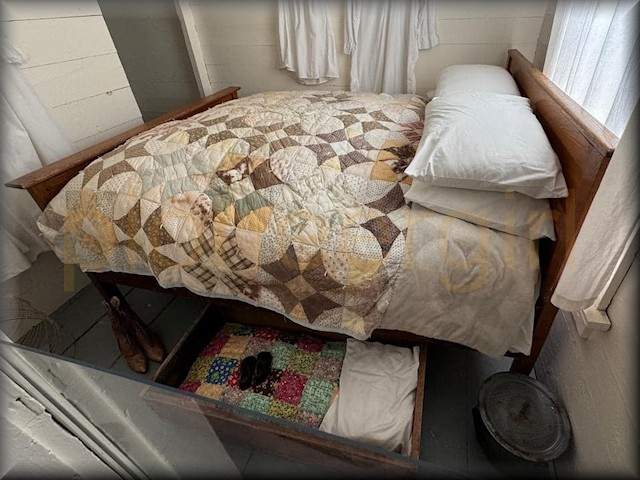
[top] Packing box trundle bed on display at the Surveyors’ House in De Smet; [bottom] Trundle bed at Masters’ Hotel in Burr Oak.
A trundle is a little wheel, so a trundle bed is a sleeping place that can be moved around, with or without wheels. Trundle beds were often used by toddlers, too large to sleep in a cradle but a child so young that they risked rolling or falling out of a regular bed in their sleep.
In the Little House books, young Laura and Mary sleep together in a trundle bed in Little House in the Big Woods, and Grace sleeps in a packing box used as a trundle bed in By the Shores of Silver Lake. Because Wilder changed Carrie’s historical timeline because of the order of the published books meant that Wilder also tended to ignore Carrie’s sleeping arrangements. Carrie appears to sleep with Ma and Pa in their bed in both Little House in the Big Woods and Little House on the Prairie. Although Garth Williams included a cradle in his drawing of the interior of the Kansas cabin, no cradle is mentioned in any of the published Little House books. The only time Wilder mentions a cradle is in connection with the Goff family in Walnut Grove in her handwritten Pioneer Girl manuscript. Poor Carrie seems to still be sleeping with Ma and Pa in On the Banks of Plum Creek, and it’s not until the family moves into the Surveyors’ House in By the Shores of Silver Lake that Carrie sleeps in one of the bunk beds with Grace while living in the camp shanty, then she has her own bed in the Surveyors’ House while Grace sleeps in a trundle bed. Not having a toddler sleep upstairs or in a loft where it was more dangerous to fall down the stairs or ladder than out of bed probably had more to do with the younger girls’ sleeping arrangements than their actual ages.
In February 1931, Marion Fiery (head of the Children’s Book Department at Alfred A. Knopf, Publisher), wrote to Laura Ingalls Wilder after accepting the “When Grandma Was a Little Girl” manuscript that Rose had submitted. Fiery suggested some editorial changes and ideas by which to double its length. She also provided a list of a dozen possible title changes. Among them were Little Girl in the Big Woods, The Day Before Yesterday, Long Ago Yesterday, Laura in the Big Woods… and Trundle-Bed Tales. If a trundle bed was a bed for a child, a trundle-bed tale would be a story for a child to read.
After Knopf closed its children’s department later that year, the expanded “Grandma” manuscript – now called “Little House in the Woods” was accepted by Harper & Brothers and published in 1932 as Little House in the Big Woods.

trundle bed (BW 1-2, 4-7, 10-11, 13; SSL 14, 16, 24; PG)
packing box used as a trundle bed (SSL 14)