

Laura & Almanzo Wilder house in De Smet
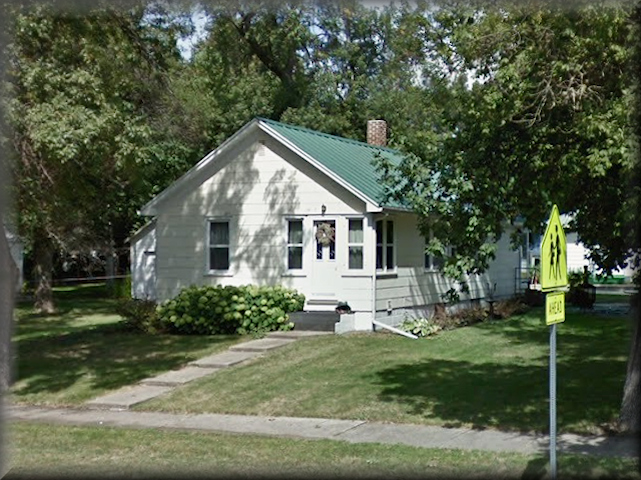
The house at 304 4th Street, De Smet, South Dakota, owned and occupied by Laura and Almanzo Wilder (and daughter Rose) from November 1892 to May 1894.
 Mr. and Mrs. A.J. Wilder, hailing from Westville, Florida, are visiting relatives and old friends in De Smet. – De Smet News and Leader, August 19, 1892.
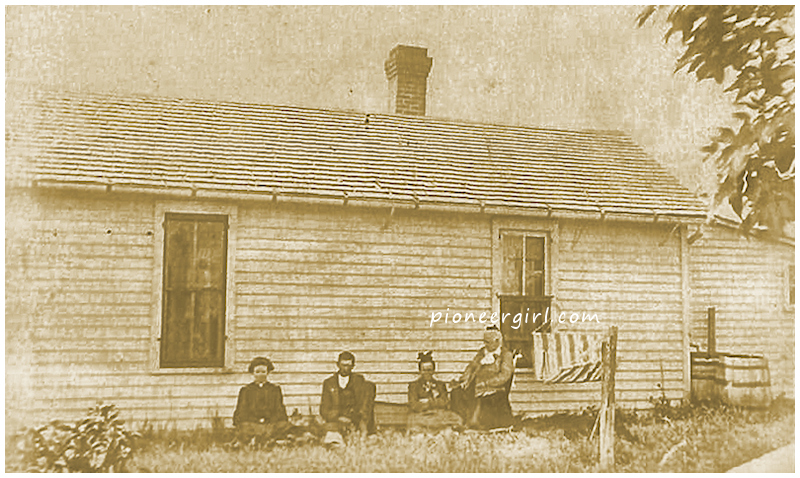 AThe 1901 photo at right is the earliest known photograph of the house the Wilders purchased and lived for about eighteen months prior to their move to Mansfield, Missouri. Click image for biggie view.
Laura purchased the Lot 14, Block 13, Brown’s Addition to De Smet – and the house on said lot – from Emil Syverson for $200 in November 1892. Laura & Almanzo sold the house and lot to Clara Abel for $350 in May 1894. Yes, the purchase deed is in Laura’s name only; the sale deed is in both Laura & Almanzo’s names. The reason that Laura only is listed as the purchaser is likely due to two mortgages Almanzo had taken out and paid back but weren’t recorded as such until after the Wilders returned to De Smet and tried to buy another property (the house in town).
Almanzo had mortgaged both his homestead and the preemption claim (former tree claim), each time shortly after making final proof. In March 1888, Almanzo mortgaged the homestead for $800. This mortgage was paid when Almanzo sold the claim in July 1888. In April 1890, Almanzo mortgaged the tree-claim-converted-to-a-preemption for $430. This mortgage was probably paid off when Almanzo and Peter Ingalls sold their sheep in May 1890. Even though both loans were repaid in a timely fashion, that info wasn’t part of the mortgage documents on file with the Register of Deeds in Kingsbury County at the time of the Wilders’ return to De Smet, so it appeared to them that Almanzo had two outstanding mortgages.
Neither loan was recorded in the courthouse as satisfied/discharged until 1893. That doesn’t mean they hadn’t been paid off earlier. There was never anything in the newspapers about Almanzo being behind on a mortgage or the default on a loan or him skipping town owing money. My guess is that it wasn’t until the Wilders were back in De Smet and buying the house in November 1892 that the Register of Deeds noticed there hadn’t been a separate satisfaction of mortgage filed for the 1890 mortgage on the preemption and sought to clear that up. There’s a notation dated 1893 at the edge of the original mortgage document for the preemption that the loan had been paid back, info provided by one of the mortgagees, but such notations usually include the book/page where a separate document is located, which is missing in this case. Both mortgages had been sold to lenders out of state, and neither had informed the Register of Deeds in Kingsbury County that the mortgages had been paid in full.
The fact that there wasn’t a separate discharge of mortgage document on the preemption claim was still apparently causing headaches in 1919, because the man who owned it at the time petitioned the clerk of courts to finally have a separate discharge document written up and filed.
Rose wrote in her intro to On the Way Home that the house was rented — the Wilders may have rented it prior to purchase upon their return to De Smet from Westville in August 1892 (maybe until the mortgage snafus were cleared up?), or perhaps they rented it back from Clara Abel for a couple of months until they left for Missouri in July 1894? Rose may have not known the whole story, guessed the circumstances, or said they rented merely to show how poor her family was. The Wilders definitely bought and sold the house and property.
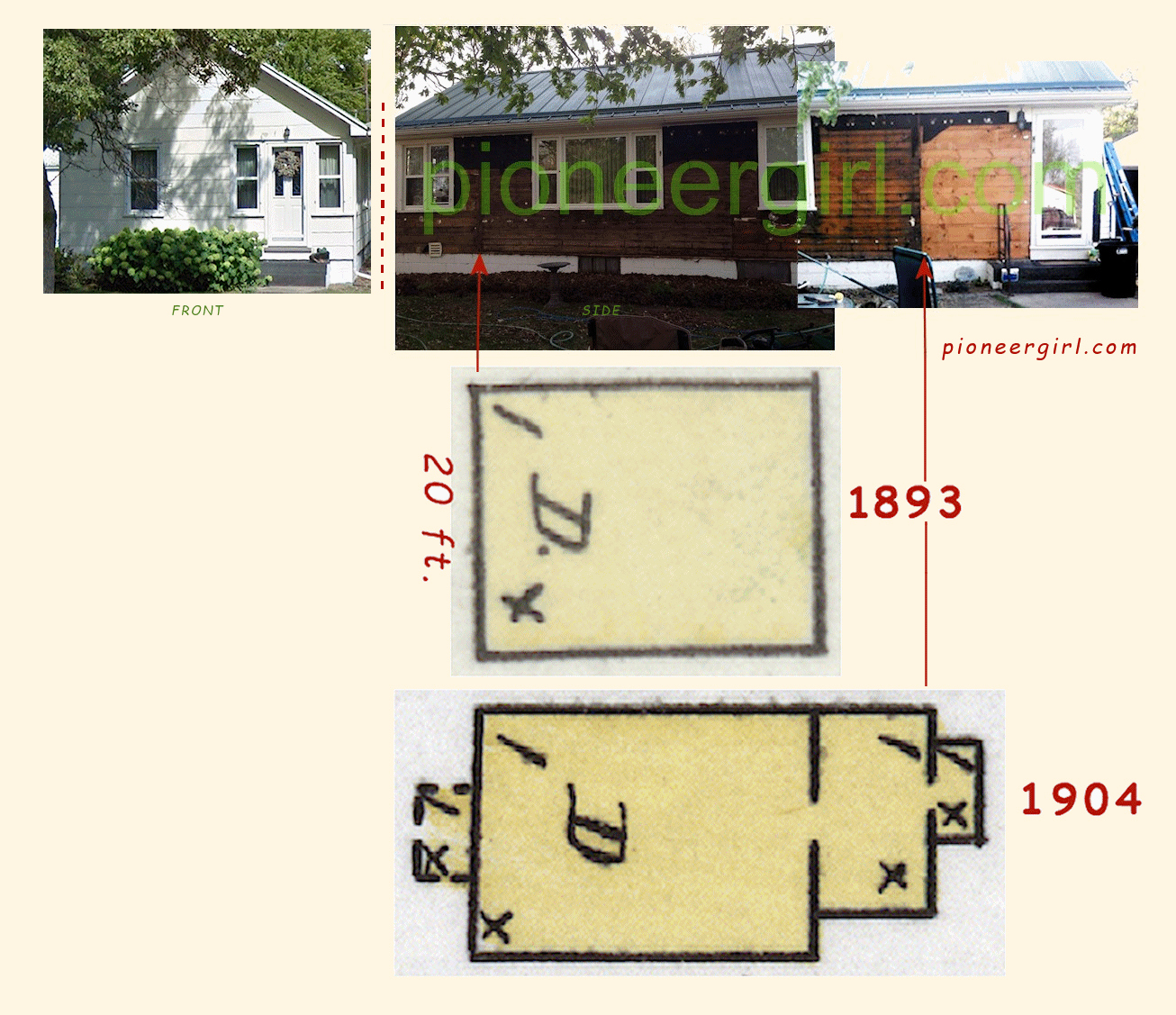
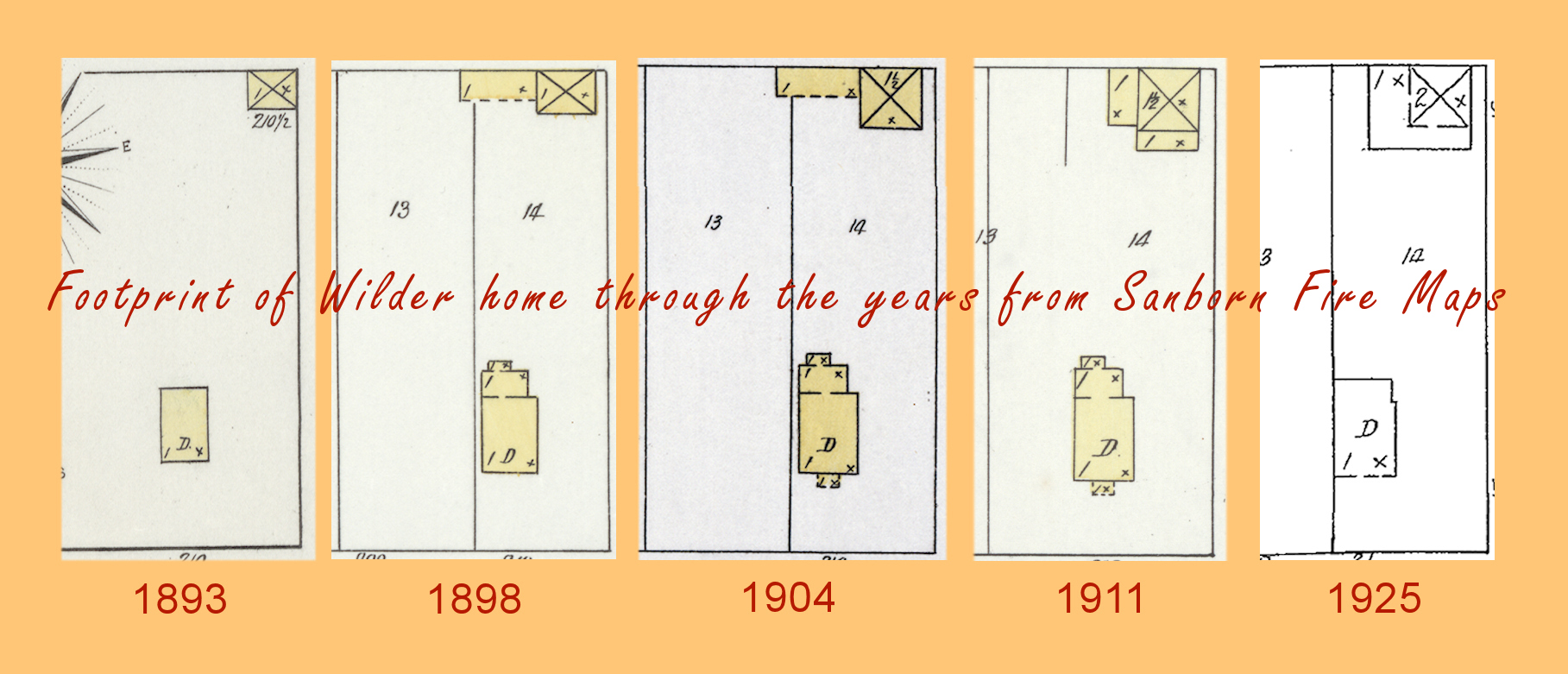
When the Wilders lived in the house, it was a rectangle approximately 20×24 feet in size. Luckily, its location behind the Methodist Church meant that some of the Sanborn Fire Insurance maps included it in drawings of town blocks with church or civil property on them (FYI: these maps can be found on the Library of Congress website). I haven’t measured the existing facade width, but I’m basing the size on the fact that the fire maps were drawn to scale; the alley was surveyed at 20 feet wide; and you can superimpose a 20 ft. alley-width square over the house drawing and it’s the same as the width of the house.
After the Wilders sold the house, there were additions made to both front and rear of it. When the house was being re-sided years ago — and with permission and knowledge of the current owners — a friend snapped some photos after the old siding and tarpaper had been removed.
You can clearly see where the original house had been added onto over the years by the changes in the boards and the vertical lines created where additions were made. What was once a small nose of an added front porch must have later been changed to a small porch on half the front; it’s now fully enclosed and is the width of the facade. Along the east side of the house (the same side shown in the 1901 photo and my pieced renovation photo), the former porch (two windows) is at left; an arrow shows where the front of the house was when the Wilders owned it. The 1893 fire map outline of the house is below the photo, as well as the drawing from the 1904 fire map. What’s interesting is that no rear addition(s) appear on 1925 and 1934 fire maps, meaning they were removed and the house was once again just a rectangle for at least a decade. The house was enlarged again after 1934.
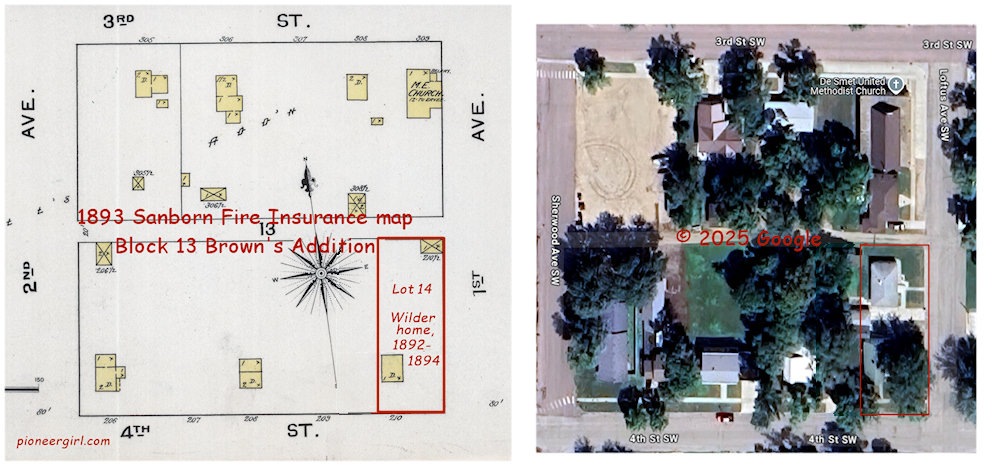
Lot 14 was at some point divided, and another house was built on the north 85 feet of the former Wilder property (this newer house faces Loftus Avenue, while the original front door of the Wilder home faced 4th Street). When the Wilders lived in De Smet, they owned all the way to the alley behind the church, and a small barn or outbuilding stood at the alley.
The former Wilder home is privately owned; please do not trespass!
 More on the Wilder House. — I haven’t looked up all the pre-Wilder deeds for the house in town on Lot 14, Block 13, Brown’s Addition to De Smet, but according to the tax records (which I do have), the house itself appears to have been built in 1891. The $40 lot was listed as owned by H. P. Hanson from 1887-1891. Was this Hans Peter Hanson, brother of August Carl Hanson (Charles & Caroline’s next door neighbor) or some other H.P. Hanson? The deed may include a wife’s name, which would help figure it out. Hans Peter Hanson was a watchmaker and jeweler who had a store in De Smet that LIW never mentioned. He later became a doctor.
In 1892, Emil Syverson is listed as the owner of Lot 14 according to the tax records for the year, and there’s now a $75 structure on the lot. That suggests that Syverson probably built the house or had it built, but did he ever live there? The deed of sale to the Wilders in November 1892 says Syverson and his wife were “of Hamlin County,” not Kingsbury.
There’s a bio of Emil Syverson in Doane Robinson’s HISTORY OF SOUTH DAKOTA (Volume 2), published in 1904. Link below so you can read it yourself. It says that Syverson “returned to South Dakota” in 1887; he’d previously lived in Lead and/or Deadwood and worked as a sawyer (someone who cuts down trees) for a few years beginning in 1879, then he lived with his parents in Wisconsin and was a schoolteacher before moving to Kingsbury County. The Kingsbury County News dated May 8, 1888, reported that Emil Syverson attended teacher’s institute that week.
I haven’t yet gone through the school records I photographed to see if he taught in the county, but his bio says he was in high school in De Smet in 1888, which means he was a classmate of Carrie Ingalls. In The Ingalls Family of De Smet (red cover, 2001) on page 22, see the picture of Carrie and classmates. The tall guy in the center on the back row is said to be “Amo Severson,” who I’m guessing is actually — ta da!! — EMIL SYVERSON!
In 1889, Emil went to business school in Valparaiso, Indiana, graduating the next year. He returned to South Dakota, settling in Bryant, where he went to work as bookkeeper in the Merchants’ Bank, becoming president of the bank in 1900 at age thirty. No clue if the De Smet house was an investment or if he had plans to work in De Smet. Emil married Inga Kragh in Brookings in August 1892; was the house built for them to live in?
I feel like there’s a connection between the Hansons and Emil Syverson that I’m missing. It may just be that both simply ended up in Lead/Deadwood at the same time and came from the same place in Norway. Both families are mentioned in the same newspaper articles in connection with each other.
 Since Robinson’s history was published in 1904, the bio of Emil Syverson was published while he was still a young man in his prime. What happened next?
During his banking career, Emil Syverson (1869-1948) was at one time president of the Commercial Bank of Watertown, incorporator of the Farmers State Bank of Norden, purchaser of the State Bank of Willow Lake, purchaser of the Goss block in Watertown (for which he paid $56,000), principal owner of the Watertown Drug Company, and was in line to run for state senator. He had a wife and children and a big old showplace of a house in Watertown, and he was active in his church and social clubs.
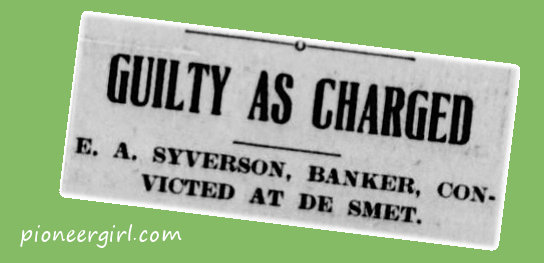
In 1914, it all fell apart when bank examiners discovered that there was about a $100K shortage in bank funds. Emil and his son Ernest (who was working for his father) had been guaranteeing worthless loans right and left, then they cleaned out the bank’s cash reserve and both high-tailed it. Emil was arrested in Texas just miles from the Mexico border, and Ernest was arrested in Iowa. Emil was charged with three counts of bank fraud, was found guilty, and sent to prison for two and a half years. It was a big deal in the area at the time, of course, with multiple banks involved and the trial held in De Smet, and newspapers all over the country picked up the story, calling it the “bank wrecking” case. The Kingsbury Journal in 2024 even published multiple “looking back” articles about it.
After Emil got of of jail, the family remained in Watertown for a while, then they moved to Missouri, where he hopefully stayed out of trouble (and banking).
📍LINKS:
EMIL A. SYVERSON bio

Wilder home in De Smet on 4th Street (OTWH intro by Rose Wilder Lane)