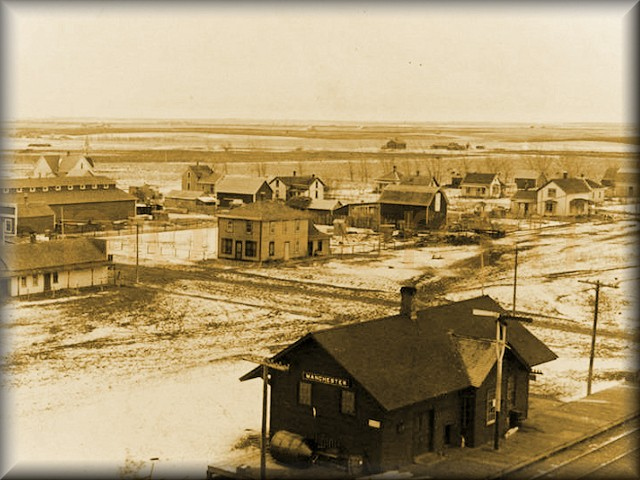
Manchester, Dakota Territory
Town on the Dakota Central branch of the Chicago and Northwestern Railroad in Kingsbury County, about nine miles west of De Smet. Originally called Fairview, the name was changed when it was learned that another town by that name already existed in the Territory. It was named after early homesteader, Chester Manchester.
First issue of the Manchester Times, a 6 column folio edited by L. L. Bancroft. – Iroquois Herald, July 25, 1884.
June 24, 2003, Manchester, South Dakota, was destroyed by an F4 tornado with winds estimated to be up to 260 miles per hour. A monument to the early pioneers and residents of Manchester was dedicated on June 23, 2007; the monument was built on the site of the former town hall building which had been destroyed by the tornado.
In These Happy Golden Years (see Chapter 14, “Holding Down a Claim”), Mrs. McKee, a dressmaker in De Smet, was going out to “hold” their claim one summer while Mr. McKee remained in De Smet, and she wanted Laura to go and stay with her and her daughter because she was afraid to be on the claim.
“Where is the claim?” Pa inquired.
“It is some little distance north of Manchester,” said Ma. Manchester was a new little town, west of De Smet.
In her handwritten Pioneer Girl memoir, Laura wrote that on the train to Manchester from De Smet, she recognized and talked to Will Barnes, an acquaintance from Walnut Grove. Note that this is a different Will Barnes than the brother of Visscher Barnes with the same name, who lived in De Smet.
Early in 1880, a townsite was located on the claim of Elverton Manchester about 9 miles west of the De Smet townsite, and named Fairview. As there was already another Fairview in Dakota Territory, the name was soon changed to Manchester.
In November 1880, Nathan Dow, William Dunn, Benjamin Dow, and Ain Bump filed on claims south of Manchester. They spent the winter back east, arriving in De Smet after the Hard Winter on the second train coming over the rails.
Manchester post office was established on June 29, 1881, and its first postmaster was Chester Manchester. In 1883, the population of Manchester was 153.
📷 PHOTO: In the composite image, the Manchester monument is shown at upper right, with a photo of the town hall and other buildings still standing when I was there years before the tornado. Photo at left is of the town sign I took a month after the tornado. Lower left photo is an early postcard view and shows the depot, with Kingsbury Street to its east. Background image is of the 2003 tornado.
Although Wilder wrote in Pioneer Girl that she went to Manchester with the McKees “early in March,” this can’t have been the case. The De Smet Leader, April 21, 1883, reported: “Mr. McKee has built a new house on his claim northwest of Fairview, and his family arrived here Tuesday.” April 17 was Tuesday, marking that as the date that the Mrs. McKee and daughter Mary [and possibly Laura Ingalls] arrived at the claim. Exactly six months after first filing, James McKee preempted. The October 27, 1883 De Smet Leader reported that “J. W. McKee, of Manchester, came to the county seat on Thursday to prove up and came in to tell us that he expects soon to remove to Pierre and engage in the hardware business. Sorry to have him leave the region.”
Manchester depot and hotel. On March 31, 1883, The De Smet Leader reported in their “From Fairview” news: “Who will come and put up a good hotel at Fairview? We must have one…” — On August 18, 1883, the Leader reported that Manchester was soon to have a hotel, to be built by a Chicago man, but this didn’t come to fruition. On November 3, the Leader reported Manchester’s despair at still not having a hotel, which forced traveling men to conduct their business in town between trains. Although Laura wrote that she and Mrs. McKee and daughter spent the night at “the hotel in Manchester,” this appears to have been impossible. In fact, even the Manchester depot was still under construction during mid-August, 1883, and there was no hotel in Manchester as late as 1888. It’s unclear why Wilder fictionalized so much of the story – even in Pioneer Girl.
Asa F. Armstrong came to Kingsbury County from Steele County, Minnesota, and in 1883, he was one of only three tax paying business owners on the four blocks of the original town of Manchester, building a store on Lot 1, Block 3. He advertised “Groceries, Provisions, Flour and Feed, Meats of all kings, Canned Goods, Notions, Confectionery, Tobacco & Cigars.” Such was Mr. Armstrong’s business that he was forced to enlarge his building almost as soon as it was constructed. The other two business owners at the time (also on Block 3) were D. McPherson and J.B. Wheeler; there had also been set aside two lots at the northeast corner of Block 1 for the schoolhouse and school grounds.
That summer, Asa Armstrong’s brother, David, visited their old home at Medford, Minnesota, returning with their parents, Maria & Seth Armstrong. Maria Armstrong purchased two lots on Block 3 behind Asa’s store building, and it was on the corner of Kennedy and Center Streets that the first hotel was eventually built. It’s not known when it opened, but David Armstrong was running the hotel in Manchester in 1900. The photo here was taken after statehood, and shows the west side of Block 3 looking south towards the railroad tracks. Asa Armstrong’s store is the building nearest the camera, and the hotel (when built) would be behind it.
The schoolhouse in Manchester was built in June 1883. The first schoolhouse was located on Lot 2, Block 1, and like De Smet, a larger schoolhouse was later built. In Manchester, the new school was located northeast of their first schoolhouse.
An active town needed a newspaper, and Leroy Bancroft (1856-1933) started the Manchester Times in July 1884. After the town of Bartram in northwest Kingsbury County burned several years later and a new townsite was located near the old, Bancroft was lured away from Manchester by the promise to name the new town after him if only he would come and start a newspaper there, which he did. The Bancroft Times struggled, and Leroy turned to teaching to earn enough money to be able to publish the paper. He abandoned both town and paper in 1891, moving to De Smet and taking on odd jobs, paper hanging, and clock repair while caring for his invalid wife. After her death in 1925, Leroy Bancroft lived in rooms at the rear of Charles Tinkham’s furniture store. Leroy Bancroft died in 1933 and is buried in an unmarked grave in the De Smet Cemetery with his wife and infant daughter (their graves are marked), just north of Grace and Nate Dow.
According to George Hall in his Kingsbury County: A County to Behold, In a State to Behold (1993), once they lost their newspaper, the town of Manchester never quite recovered. Little House fans know Manchester as where Grace & Nate Dow once lived, and Manchester Township as the birthplace of artist Harvey Dunn as well as the location of Nate Dow’s tree claim and his father’s homestead, where Grace and Nate lived. And… as the town where fictional Laura Ingalls took the train to a depot that hadn’t been build yet and spent the night at a hotel that didn’t exist.
The image below shows a 1909 atlas map of Manchester on which the location of the three 1883 businesses are shown in yellow. The location of the schoolhouse built in 1883 is also marked. (Note that neither the blocks nor lots in Manchester’s original town are numbed in the same configuration as De Smet’s original town blocks and lots.) Compare the 1909 map to the recent aerial photo of Manchester. The location of the depot and hotel have been added for reference, although neither were in operation in March or April 1883, when Laura Ingalls was first there as a teenager.

Manchester, Dakota Territory (THGY 14; PG), see also James McKee family, Will Barnes, video of Manchester tornado on YouTube HERE
hotel (THGY 14: PG)