

telegraph
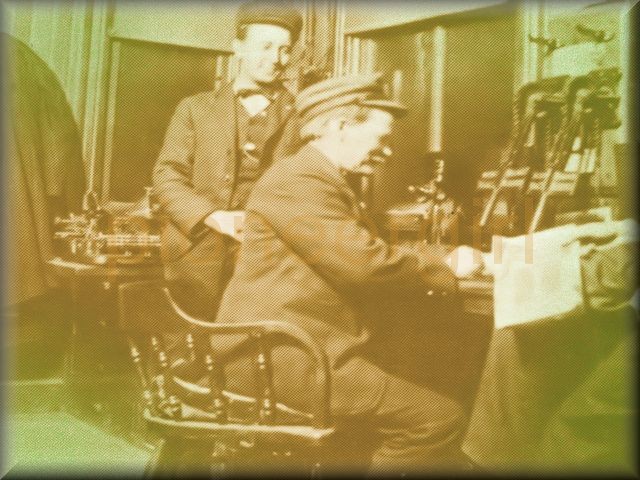
An apparatus, or a process, for communicating intelligence rapidly between distant points, especially by means of preconcerted visible signals representing words or ideas, or by means of words transmitted by electro-magnetism. In the offices in the United States where the Morse telegraph is employed, the recording instrument is now little used, the operator trusting entirely to the sound caused by the opening and breaking of the circuit, which, in the registering apparatus, are made to trace upon a ribbon of paper the lines and dots used to represent the letters of the alphabet. Electric telegraph, or electro-magnetic telegraph, a telegraph in which an operator at one station causes words or signs to be recorded or exhibited at another, by means of a current of electricity, generated by a battery, and transmitted over an intervening wire. — Webster, 1882
 A telegraph line is being put in place through Kingsbury County. – Daily Press and Dakotaian (Yankton), May 6, 1880.
De Smet has telegraphic communications with the outside world. -Daily Press and Dakotaian (Yankton), May 26, 1880.
The telegraph company has established what they call a letter message that will be of great benefit to the public. A message of fifty words or less filed before midnight will be sent at the day rate of a ten word message and it will be delivered at eight o’clock the next morning. This will be of great convenience in sending orders and messages where quick delivery is important and it is expected that there will be extensive use of the privilege. – De Smet News, April 1, 1910.
The C. & N.W. has decided upon the use of telephones for train orders, and a system will this spring be installed on the Dakota division. Wires will be on poles on opposite side of the track from telegraph wires in every case. – De Smet news, March 24, 1911.
C&NW Depot Here Closed; Came Tuesday. The Chicago & Northwestern railway depot at De Smet–last in operation in the county–was closed yesterday (Wednesday) in an order that covered 16 of the company’s stations in South Dakota. – De Smet News, January 9, 1969.
 The first mention of the telegraph in the Little House books is in By the Shores of Silver Lake (see Chapter 3, “Riding in the Cars”), when Laura describes for Mary how fast the train is going by noting the swooping wires between telegraph poles alongside the railroad tracks: “One—oop! two—oop! three!” Laura also notices the “green glass knobs that glittered in the sunshine,” the glass insulators which separated the telegraph wire from the wooden telegraph pole. In times of rain or snow, the wooden pole would become wet and could conduct electricity to the ground, thus short-circuiting the line. The old telegraph pole with glass insulators shown here is still standing alongside the railroad tracks near De Smet, South Dakota. The wires are down and it has not been in use for many decades. There are numerous telegraph poles still standing; look for them next time you’re in Kingsbury County.
While Laura noticed green insulators, but they were made in number of different colors over the years, including clear, amber, aqua, green, purple, and red. Do you have a green glass telegraph insulator in your Little House collection? I hear they’re all the rage with folks back east.
Highly interesting experiments in electro-magnetism are conducted by Prof. James Woodworth, at the depot. They are most deeply interesting to the experimentee. The look of pained astonishment which he assumes is only equaled by the gentleman who discovers that some guileful plebian in whom he confided has worked on him a twenty cent piece for a quarter. – De Smet Leader, January 27, 1883. FYI: A twenty-cent piece was made in the U.S. from 1875-1878.
Although the telegraph is mentioned by Charles Ingalls in The Long Winter as one of the new-fangled things that are “good things to have” but people depend on them too much (see Chapter 19, “Where There’s a Will”), it’s not until Laura attends a party at the depot in Little Town on the Prairie (see Chapter 20, “The Birthday Party”) that readers learn that Ben Woodworth’s brother, Jim, is the telegraph operator. Wilder wrote that as she and Mary Power stood outside the depot’s waiting room door, not knowing whether to knock or to go right in, they could see lights upstairs over the depot as well as in the telegraph office downstairs; she also wrote that Jim was still at work and they could hear the “chattering” of the electric telegraph. If you’re familiar with the old depot building in De Smet (now the Depot Museum), you’ll know that the office with its bump-out window is on the north side of the building, facing the tracks. This depot replaced the Little House era depot that burned in 1905. The old depot was on the north side of the railroad tracks, so the office window faced south, which is why Laura and Mary Power could see Jim at work as they approached from town.
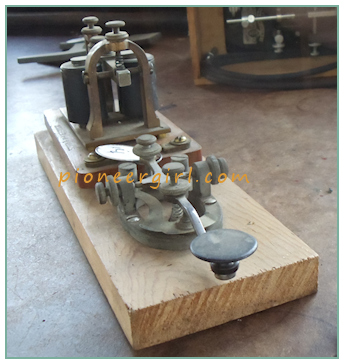 Brass telegraph key. The telegraph key shown here was the one first used in the 1906 depot, and is on display at the Depot Museum. The key is used to connect or break the electric circuit when sending messages. A spring with an adjustable tension screw keeps the upper contact (called the hammer) separated from the lower contact (called the anvil) and forces the arm to raise after each short (dot) or longer (dash) finger tap on the knob. The sequence and spacing of dots and dashes transmitted a message in Morse code to the telegraph wire via nearby battery power wired to the apparatus as needed, where it was heard up and down the stations connected. There were separate wires for block messages or Western Union telegrams.
A separate sounder amplified the clicks and clacks of incoming messages. When sending messages intended for certain railroad stations – or when referring to railroad towns in messages – each town had its own shorthand code: De Smet was “DS”; Tracy was “D”; Manchester was “MN;” Iroquois was “Q”; and Lake Preston was “SO”. There were also shortened common phrases; I bet you can figure out what “GM” and “GN” stood for.
The practice of shocking people with the telegraph apparatus wasn’t exclusive to Jimmie Woodworth; it was a trick of the trade among operators and unenlightened guests. A son of the first depot agent in the 1906 De Smet depot, Al Stimson wrote that he bribed a bunch of his young friends to help scrub the office floor, and when one friend showed interest in the telegraph key attached to a live wire, he explained that you “pulled this lever to the side” and “then you send with the key and it goes as far as the wire goes.” Stimson signaled for the friends to all hold hands and as they did, he pushed his friend’s hand against the metal part of the key, resulting in Stimson “hanging to a shelf, the friend sprawled on the desk, and the others prayerfully on their knees.” [H.S. Stimson, 1972]
From my old blog dated February 1, 2006:
-. — / — — .-. . / .– . … – . .-. -. / ..- -. .. — -. / – . .-.. . –. .-. .- .–. ….
 After 145 years, Western Union has quietly stopped sending telegrams. On the company’s web site, if you click on “Telegrams” in the left-side navigation bar, you’re taken to a page that ends a technological era with about as little fanfare as possible: “Effective January 27, 2006, Western Union will discontinue all Telegram and Commercial Messaging services. We regret any inconvenience this may cause you, and we thank you for your loyal patronage. If you have any questions or concerns, please contact a customer service representative.”
The decline of telegram use goes back at least to the 1980s, when long-distance telephone service became cheap enough to offer a viable alternative in many if not most cases. Faxes didn’t help. Email could be counted as the final nail in the coffin.
Western Union has not failed. It long ago refocused its main business to make money transfers for consumers and businesses. Revenues are now $3 billion annually. It’s now called Western Union Financial Services, Inc. and is a subsidiary of First Data Corp.
The world’s first telegram was sent on May 24, 1844, by inventor Samuel Morse. The message, “What hath God wrought,” was transmitted from Washington, D.C. to Baltimore. In a crude way, the telegraph was a precursor to the Internet in that it allowed rapid communication, for the first time, across great distances.
Western Union goes back to 1851 as the Mississippi Valley Printing Telegraph Company. In 1856 it became the Western Union Telegraph Company after acquisition of competing telegraph systems. By 1861, during the Civil War, it had created a coast-to-coast network of lines.
Other company highlights: introduced the first stock ticker (1866), introduced money transfers (1871), became one of the original 11 stocks tracked by the Dow Jones Average (1884); introduced the first consumer charge card (1914), began using a transcontinental microwave beam to replace land lines (1964), launched Westar I, the first U.S. dedicated communications satellite (1974).
On Jan. 26, the last day you could send a telegram, First Data announced it would spin Western Union off as an independent, publicly traded company.
FYI: Morse Code translator HERE.

telegraph / electric telegraph / telegraph instrument (TLW 19, 21; LTP 20; PG); see also depot / station, Horace Woodworth family
brass telegraph key (LTP 20)
electric telegraph (LTP 20)
insulators (SSL 3)
office (LTP 20)
operator / telegrapher (LTP 20; PG)
poles (SSL 3; TLW 31; PG)
wire (SSL 3; PG)